
The Attic Kingdom: The Making of a Collector
Part VIII of James Strand and Me, a Book Collecting Horror Story

When thieves looted James Strand’s house in Portland, Oregon, in August 2023, they did more than steal $2 million in rare books and comics. They also destroyed perhaps the greatest collection of H. P. Lovecraft and his circle still in private hands.1
[If you are new to this, the James Strand story starts here. Or go all the way back to the beginning, with my tales of book crime.]
Strand was a born collector, a trait he may have inherited from his mother, whose acquisitions eventually overflowed their house. His life could have taken another path, however. As a boy he dreamed of far-off places, and he tried to leave Portland, only to wind up living at home with his parents. This is that story.
In the post-war years Lents, the perpetually run-down neighborhood in southeast Portland where James Strand was born, lived, and died, was a blue collar corner of the city. When Jim was in first grade, Woody Guthrie rented an apartment on a street between Strand’s school and his home. Jim likely walked by while Guthrie was in town composing songs about electricity for a power company.2
The neighborhood was only half-built then, with vacant lots on many streets, large tracts of undeveloped land, and sprawling properties with ramshackle old houses and outbuildings. Three blocks east of the Strand house on Yukon Street, the road came to a swampy end at the Beggars Tick Marsh. Just a block away, Strand’s uncle Emil Abplanalp ran a manure fertilizer business. Cemeteries, quarries, and farms surrounded empty plots and scattered houses. When Strand’s mother was growing up, the region had been mostly dairy farms; by mid-century it was starting to look more like a city, but for Jim, who turned thirteen during the summer of 1948, it was a land of adventure.
Americans tend to think of the immediate postwar period as a golden era. A twelfth-grade education was all that was needed for a good-paying job. Strand’s parents, both children of immigrants, lived that American dream. With high school diplomas, Orville, a Linotype mechanic, and Rose, a county librarian, spent frugally and managed to buy a house in 1935, when their daughter, Sally, was two and Rose was pregnant with James. Over time, they parlayed their working-class incomes into a small real estate empire, including a house across the street for Rose’s ever-expanding collections and two others nearby, one for each child.
Of course, the land of opportunity wasn’t open equally to everyone, and there were disturbing undercurrents beneath the placid surface of 1950s America. The alienation that J. D. Salinger portrayed in The Catcher in the Rye (1951) had roots going back to the 1920s. In the pulp magazine Weird Tales, H. P. Lovecraft published horror stories set in New England towns hollowed out after the collapse of the whaling industry, and a young Dashiell Hammett serialized one of the bleakest, most amoral detective stories ever set in type, Red Harvest, in Black Mask magazine in 1927. Comic books, launched in their modern form in 1938, grew out of the pulps, depicting violence and horror on their covers that only superheroes had a chance of defeating.
James Strand plowed through comics and pulp magazines as a young teenager. He would have recognized the darker themes in the stories he read. Some of the older boys in Lents in the late 1940s drifted into mischief and loosely organized cliques, the predecessors to the “gang of housebreakers”3 that would steal Strand’s books and comics seventy-five years later.
Some of the grownups in the neighborhood behaved no better than the young men. During the 1940s, an elderly man named Julius Bock ran a fireworks stand on a junk-filled compound not far from the Strand house, selling cherry bombs and blockbusters year round at SE 92nd and Powell.
The whole Bock family was a piece of work. Mr. and Mrs. Bock sold bootleg liquor to soldiers during the First World War.4 Their son was in and out of jail most of his life, and his recklessness led to at least one death and many injuries. In addition to dealing in fireworks, the Bocks also wholesaled eggs and sold firewood to businesses still using wood as fuel. The Bocks’ son caused two accidents while delivering for the company. In one, a woman died after being crushed between the truck and a wall.5 In another, a family of five was severely injured when their car collided with the truck as it sat on a dark road without any lights.6
The elder Bock also spent a few days in jail, in his case for hitting a fifteen-year-old girl with a hammer during an argument over a pay phone. In May 1948, he got into another fight with a child. Bock hit the twelve-year-old Albert Drake on the head with a half-inch iron bar after mistaking him and some other boys for “a gang that ha[d] been bothering him.”7
Strand would have known about the fight with old Mr. Bock because Albert “Bud” Drake was young Jim’s only friend, and they both loved fireworks. Drake grew up to be a college English teacher, and he wrote a thinly fictionalized novel, One Summer, about his and Jim’s adventures during the months before they started high school in 1948. Most of what we know about Strand’s teenage years comes from Drake’s book.8
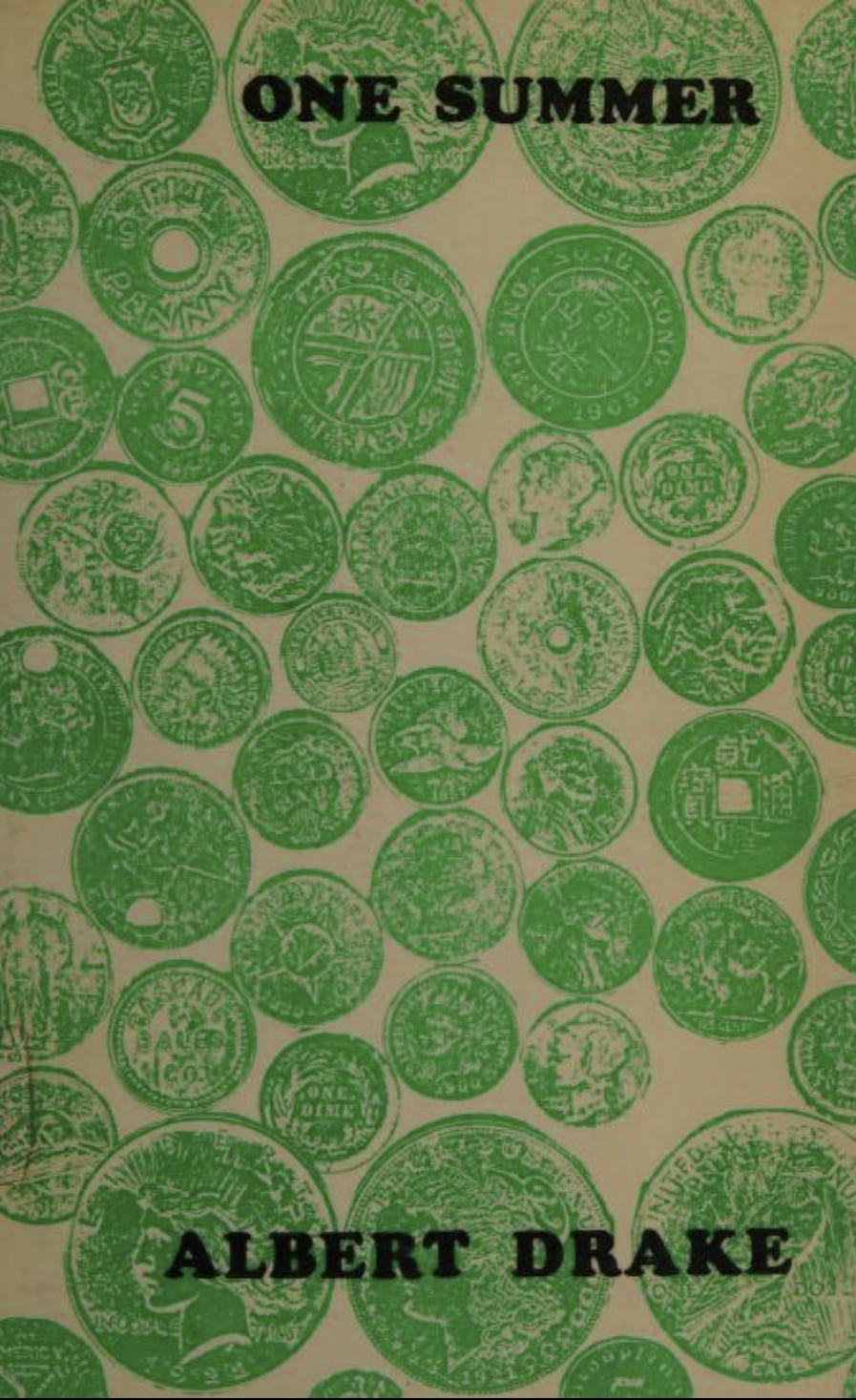
The Strand family lived in a small two-bedroom house. Jim and his older sister likely shared a room as small children. As they grew older, Sally got the second bedroom. Sally was in many ways Jim’s opposite. She was pretty, outgoing, and joined clubs and community activities. Jim, a gangly loner, retreated into the small bedroom that his father constructed out of the attic crawl space.
The entrance to the room was up a ladder and through an access panel in the ceiling. When Bud came to visit, he had to navigate through the house, removing his shoes to cross Mrs. Strand’s gleaming linoleum. Bud would climb the ladder in an alcove off the kitchen and give the secret knock at the trap door.
“Your name,” Jim would say from inside. “Speak, son of a camel.”
A bolt would slide and the trap door would open. Once it closed behind him, Drake later wrote, he was in another world. Short walls met a sharply pitched ceiling. The room was finished entirely in knotty pine that seemed to glow in the lamplight. It looked more like a hunting lodge than a thirteen-year-old’s bedroom. Even as a young teenager, Jim was too tall for the space and couldn’t stand up straight. Bud wondered if that was why Jim always walked bent over, as if he were facing into a wind.
“The limited wall space was loaded with weaponry,” Drake wrote. Jim had “two rifles, a pistol, a dueling foil, a hunting knife, and two throwing spears.” On a bookcase he kept adventure novels, pulp science fiction, and Stoeger Arms catalogs. Decades later, Drake wrote that in Jim’s room he felt “beyond time and space,” as if he were “part of the pyramids, the eternal sands of the desert, the Crusades.”9
It was Jim’s fascination with the Arab world that first attracted Bud’s attention.
In eighth-grade art class, most of the boys drew flat pictures of crude spaceships and stick-figure soldiers. One day, Bud walked by Jim’s desk in the back row and noticed he was working on a large sheet of paper covered with drawings. Every inch was filled with “men shooting arrows, throwing spears and battleaxes, dumping boiling oil from ramparts; there were two catapults, a reserve of cavalry, flags, banners, drummers, buglers, tents.” The drawing was intricate and dense, telling a hundred stories when most of his classmates drew single scenes.
What is that? Bud asked.
Jim looked up. The Saracens are battling the Infidels, he said, as if that explained everything.10
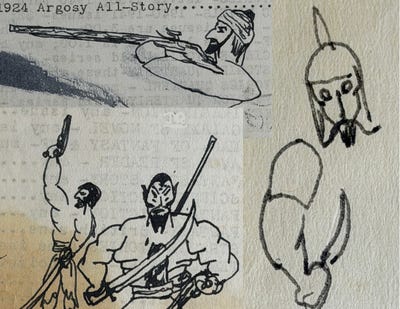
Bud was amazed, and he and Jim became friends. In One Summer, Drake credits this friendship with changing his life. Jim introduced him to an intellectual world that would lead him to a career as a writer and professor. There was a certain irony in that because in junior high and high school, one of the nicer nicknames the other kids had for Jim was “the professor.”11 Instead, it was Bud who went on to teach at a college and write pieces for the Oregonian newspaper12 while Jim worked for five decades in the paper’s print shop and advertising departments.
Over the eighth-grade school year, Bud and Jim spent more time together. One thing they had in common was a mania for comic books. Both boys made regular visits to the Mt. Scott Drug Store for its magazine rack. On Sunday mornings, when the pharmacist arrived late, they could read a dozen comics in half an hour before being booted out. Neither cared much for superheroes like Batman or Superman. They preferred the adventures of Chuck Chandler, the orphan crime fighter in Boy Comics and the “true” gangster stories in Crime Does Not Pay. Sometimes they splurged and put down ten cents to buy a copy to take home.
Violent and disturbing images proliferated on the covers of Golden Age comics in the 1940s and into the 1950s. The comics showed stabbings, shootings, torture, and female characters bound with ropes and chains.

Publishers knew their audience—primarily white boys—and so they generally did not capture the growing Civil Rights Movement or the frustration and alienation felt by many women. Black characters rarely appeared in comics, and women kept finding themselves tied up awaiting rescue.
Kids like Jim and Bud ate it up. By 1947, the fifth year Crime Does Not Pay was published, it boasted 6 million readers on its cover. Comic book writers and artists, despite their lowbrow reputation, connected with a riptide of American culture. The crime comics devoured by Jim and Bud reflected unease churning below the surface about organized crime in cities and the criminal gangs forming among disaffected youth.
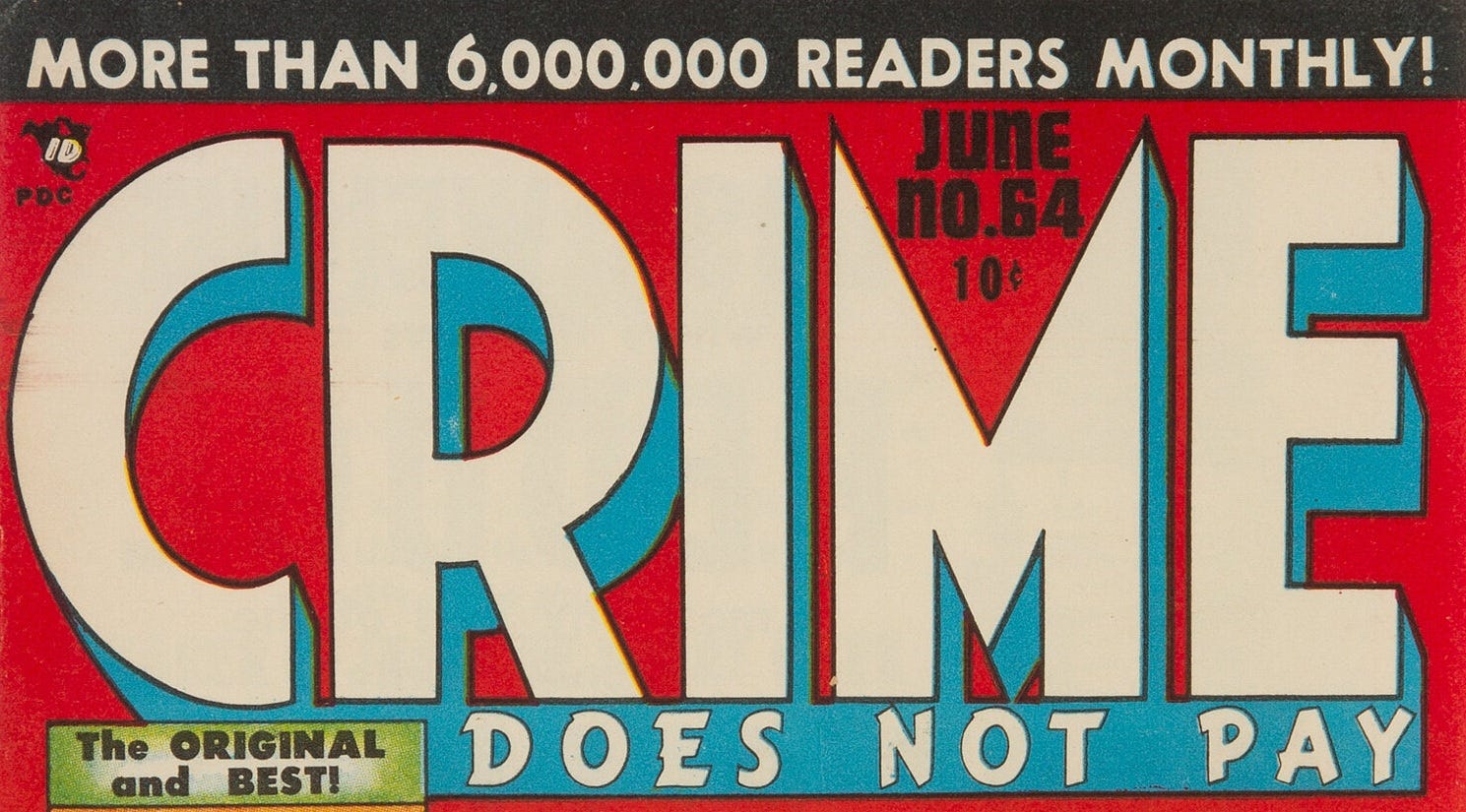
Beginning in the 1980s, Strand began rebuying the comics he owned as a boy and saw on the magazine rack of the Mt. Scott Drug Store. He routinely paid fifty to one hundred thousand times their original dime price for a single issue. Eventually, Strand owned more than one hundred virtually as-new copies of the comics he read as a teenager. Most of them are now in the possession of collectors who have no idea they are stolen.
James Strand’s influence on Albert Drake went far beyond comics. Bud followed Jim as he explored history, recreating the victories of the French Foreign Legion and bloody battles of the First World War like Verdun, Anzio, and Belleau Wood. When the boys weren’t certain about the facts of a battle or a weapon, they went to the library to do research. Their interests, Drake later wrote, “teetered between scholarship and frivolity.”13
Jim’s true obsession was the Saracens—an archaic term for Arabs and Muslims dating back to the Crusades. In the first half of the twentieth century, pulp magazine writers cast the Saracens as ruthless adversaries of their heroes. The best-selling adventure writer Talbot Mundy referred to them in several novels. The Saracens also intrigued H. P. Lovecraft, who depicted them protecting “wild secrets” in one story and living in a “glittering faery necropolis on the edge of the Arabian Desert” in another.14
The Saracens were exotic people worshiping a vengeful God, at least in the pages of pulp magazines. The young Jim Strand identified with them, even though it’s hard to imagine he ever met a Muslim while growing up on the distant edge of Portland.
Late in his life, Strand paid $55,000 the handwritten manuscript of “Imprisoned with the Pharaohs,” a story Lovecraft ghostwrote for Harry Houdini that mentioned the Saracens. It’s hard not to connect the young Jim who identified with the Arabs fighting crusading knights with the advanced collector seventy years later spending his annual book budget on a Lovecraft manuscript set in Egypt.
On Saturdays, Bud joined Jim on the number 14 bus, which went from Lents, across east Portland, over the Willamette River, and into downtown. As an adult, Jim would ride the same bus back and forth to work for decades. Even after he retired, he continued to have packages sent to an address at the end of the number 14 bus route. In his 87 years living in Lents, he probably made the round trip thousands of times.
In downtown, Jim took Bud to his favorite places. He liked to visit the Oregon Historical Society to see their flintlock and cap-and-ball firearms and the art museum for its medieval artifacts like a two-handed broadsword. Jim also went to junk stores, second-hand stores, and used bookstores. “A whole new world opened,” Drake later wrote.15
Jim and Bud hunted squirrels in the vacant lots between their houses, sometimes startling neighbors with the cracks of their rifles, but more often they roamed unnoticed and unsupervised, imagining a Middle Eastern landscape instead of the fields of southeast Portland.16
They reenacted battles between the Saracens and English knights, building forts from scrap metal and salvaged lumber and fashioning improvised wooden weapons and garbage-can-lid shields. At the end of the summer, following weeks of preparation, they clashed in one last fight, a battle to end all battles.
“Kill for the love of Kali!” Jim yelled, before throwing a firecracker-stuffed apple at Bud’s fortress. As Bud’s own homemade grenades flew at him, flashing bright in the evening twilight, Jim hurled insults pulled from the pages of the pulps. “Die, son of a camel!” It was, Drake wrote, “the history of warfare compressed into a few hours in this edge of the city field.”
Each warrior built a fire and quickly smoke filled the field between them, leaving them coughing in their trenches. When Jim ran out of Zebra firecrackers and apples, he charged across the open space waving his wooden sword and shouting, “Show no mercy. Spread-eagle the beggars to an anthill. Leave their eyeballs for the buzzards!”
When it was over, Jim stood victorious on Bud’s “ruined bulwarks, the firelight playing against his blackened skin and clothes.”17
The next week, the two boys started high school. It seems likely that they began to drift apart. Bud was already hanging out with older boys who had cars, part of the nascent hotrod scene developing in Portland. As an adult, Drake would chronicle the history of hotrodding in books and articles.18 Strand liked riding the bus.
Jim retreated into books and his small attic room. He grew tall and thin. His classmates called him a “pud” and “queer.” He came from a long line of hard workers, so he got a job delivering newspapers, probably for The Oregon Journal, the newspaper his father worked for. His sister worked with their mother as a page at the county library. In Jim’s senior year, he found a job as a stock clerk at the Fred Meyer supermarket.19
The year he graduated, 1953, he was one of the only students who didn’t have a picture taken for the high school yearbook, and he was perhaps the only student who didn’t fill out the senior questionnaire. Where other students indicated their future plans—Albert Drake said he was headed to Oregon State—Jim’s entry had the default response, “undecided.”
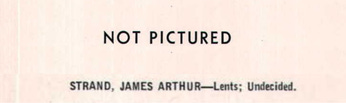
This wasn’t true. In January, he had enlisted in the U.S. Marine Corps, presumably expecting to join the real battle still raging on the Korean peninsula.
Strand reported to basic training in San Diego on July 7, 1953.
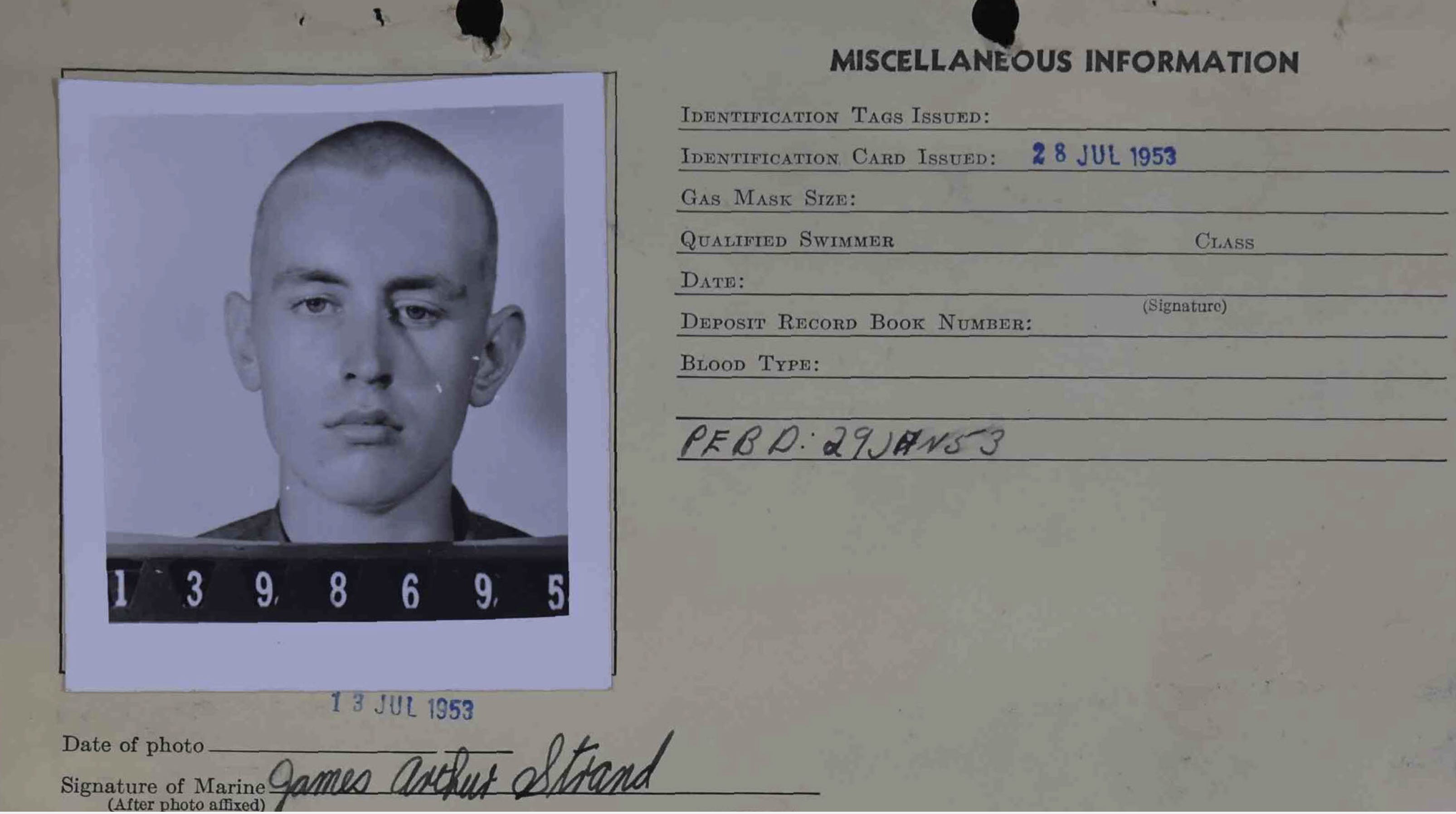
He received an honorable discharge in August after three navy physicians determined him medically unfit for duty because of a benign tumor on his left femur. He returned to Portland and moved back in with his parents. He abandoned his attic kingdom, taking over his sister’s room downstairs where he would live for the next twenty-five years. At loose ends, he threw himself into work and collecting.
To be continued…
—Scott Brown, Downtown Brown Books
Most of the records James Strand kept of his collection were stolen along with the books. Just the Lovecraft books known to be missing from surviving records is one of the most impressive collections ever assembled.
One of Guthrie’s Portland compositions, “Roll On, Columbia, Roll On,” is now the state folk song of Washington.
A phrase used by one of the FBI agents involved in the case to describe the group that organized the theft.
“Astoria Laundry Is Booze Factory” in The Oregon Daily Journal (Portland), 24 June 1918.
“Augusta Stauss Killed by Truck” in The Capital Journal (Salem, Oregon), 3 June 1940.
“Seeks $19,000 Damages” in The Oregon Daily Journal (Portland), 8 November 1936.
“Boy Struck on Head” in The Oregonian (Portland), 18 May 18 1948.
It is always risky to attribute facts to someone’s life from a novel. I have erred on the side of caution, sticking mostly to details that correlate in some way to what I know about Strand as an adult. For example, tickets and programs from museum shows about weapons survived the looting of Strand’s house; he collected guns at least as early as his 20s; in the 1950s, he bought a lot of historical fiction set in the Middle Ages.
The description of James Strand’s room is from One Summer, page 21. I confirmed the general description of the house with Strand’s niece and the antique dealer who ran the estate sale after Rose Strand died.
Description of Albert Drake (portrayed as Chris) and James Strand (Horace) meeting from One Summer, p. 23.
One Summer, p. 22.
For example, “The Magic of Indian Rock” in The Oregonian, 11 September 1983.
One Summer, p. 23.
Wild secrets from “The Silver Key”; faery necropolis quoted from “Imprisoned with the Pharaohs.”
One Summer, p. 24.
See One Summer, p. 25, p. 101, etc.
One Summer, pp. 111–115.
For more on Albert Drake and hotrods see “Remembering Albert ‘Bud’ Drake.”
For James Strand’s nicknames, see One Summer, p. 69. Information about Jim and Sally Strand’s high school jobs comes from the 1950 census and Jim’s USMC enlistment papers.
I can’t imagine the number of hours that you have invested researching this case. Thank you for generating a riveting tale for us to enjoy. Very impressive indeed.