

NOTE: You can also read about:
How AI is consuming collectible and scarce books by the thousands;
How books are ending up at a toilet paper factory in Mexico.
And an over-long data dump of everything I know about AI and destructive scanning.
Are Millions of books are being destroyed to train AI?
No, tens of millions of books are.
News reports have centered on Anthropic’s book scanning because details of its program, called Project Panama, came to light in court filings. The company’s goal was to “destructively scan all the books in the world.” However, it is far from the only company involved. The book scanning ecosystems includes AI developers, book acquisition firms, and scanning companies.
AI Developers
In a statement to The Guardian, Anthropic implied that destructive scanning was standard operating procedure, saying, “sourcing books is a widely used approach for training large language models across the AI industry.”
We should believe them.
In 2024 and 2025, the AI scanning projects mostly happened under the radar. Everyone involved signed NDAs and the companies primarily bought from mega-sellers, like Better World Books, World of Books, and Thrift Books. Individual bookstores, even Powell’s and The Strand, were considered too small.
Eventually, the need for books, particularly specialized titles, outgrew the mega-sellers, and orders began to flow last December through the used book marketplaces, beginning with Alibris before spreading to Biblio.com, Abebooks, and Amazon’s Marketplace.
Meta
It appears that Meta had a book scanning operation running simultaneously with Anthropic’s. Hints about it can be found online. It may have matched Anthropic’s in scale and destructiveness.
Meta acqui-hired the machine translation expert Kenneth Heafield and his team in late 2023. At Meta, Heafield “built physical acquisition” for text-pretraining of the Llama AI models. Physical acquisition sounds a lot like printed books.
The other suggestive evidence of Meta’s book scanning program is that Heafield left the social media company after two years and in weeks launched a book buying and scanning company with the capacity to process 400,000 books per month. Without prior experience at a company the size of Meta, spinning up an operation capable of buying and coordinating the logistics for hundreds of thousands of books would be very difficult. And probably not coincidentally, the scanning contractor used by Heafield’s startup claims to have undertaken “one of the largest scanning projects in history—digitizing millions of books” for “a major social media company.”
SpaceXAI
Elon Musk confirmed that his AI company was scanning physical books when he posted on X, “I’ve asked the SpaceXAI team to preserve any rare books in a library and scan them the hard way vs just cutting off the spine and scanning.” I doubt that Musk’s brief moment of love for books will survive his lawyers. He may have forgotten that destroying books is a requirement to make the scanning legal.
Amazon
Today (August 17), 404 Media reported that it had tracked a book purchased on Biblio to an Amazon warehouse in Las Vegas, and more specifically to a program called VGT3. According to 404 Media, they found a comment by someone on an Amazon worker forum saying VGT3 scans books. What’s curious about this is that Amazon owns both Amazon Marketplace and Abebooks, the two largest online sites for used books.
Book Acquisition Firms
Anthropic is thus just one of four top AI companies with book scanning programs (that we know about). It’s probably safe to assume the others do, too.
Anthropic and Meta seem to have handled book acquisition in-house. Now at least four companies are providing acquisition services for AI: Zoom Books, Far Corner, Last Token, and Innodata. All four of these companies appear to have moved into this line of business in the last year.
Zoom Books
The only company previously identified in the media as supplying books for destructive scanning is Zoom Books, a Canadian mega book “processor”1 similar to Thrift Books.
Earlier this year, the company hired Reed Pannell as its Chief Growth Officer. Pannell’s previous position was director of business development for World of Books, where he was responsible for “spearheading the global [business to business] sales and sourcing strategy.” World of Books, a British company, was one of Anthropic’s key suppliers, and during the two-year heyday of Project Panama its operating profit more than doubled to £21 million.2
With Pannell on board, Zoom Books rushed headlong into large scale book acquisition and a social media firestorm when a Spanish news site ran a story under a headline that translates as “The Mysterious Company that Buys Old Books to Train AI and Then Destroys Them.” Zoom Books denied that it was destroying books, but not that its customers were.

Coincidentally, the PrepFort warehouse in Wood Dale, IL, where many Zoom Books are sent, just happens to need people for “processing high volumes of books.”
Zoom Book orders dried up after the media attention. Most booksellers think they are still operating, but under one or more of the many code names associated with large orders of books. They are also approaching bookstores directly.3 The BBC reported on a bookstore in northern England that received an order from a Canadian company, very likely Zoom Books, the size of which the owner had “never seen the like of.”
Before Zoom Books went quiet,4 Pannell engaged in an online discussion about the company in a Facebook group. One bookseller accused Zoom Books of selling books it didn’t own. While the dealer didn’t use the word, they suggested that Zoom Books was what many in the trade derogatorily call a “bookjacker.” Bookjackers don’t own books, they write software programs to scrape other booksellers’ data, repackage it, and offer the books for sale at higher prices in various corners of the Internet.
Pannell emphatically rejected even the hint of the bookjacker label. “With all due respect,” he wrote, “that is categorically false.” He explained the Zoom Books’s purchases: “We just have a need for these books and are sourcing them via the marketplaces.”
Someone else chimed in to ask the question on every bookseller’s mind, “Will it continue indefinitely?” Pannell responded, “That’s the goal.” He added a smiley-face emoji.
Far Corner
Far Corner is another company buying books in bulk, primarily through Biblio (at least that’s the only site where they use their real name on the orders).
Far Corner is a bookjacker that also provides software designed for bookjackers. They call it “the world of virtual inventory.”
More accurately, Far Corner seems to have scraped listings from other bookstores to augment their own offerings. Or at least they did until about a month ago.5 Their book website, Superbookdeals, no longer accepts orders, and I could not find their seller account on Amazon. Perhaps they are too busy buying books for destructive scanning to deal with arbitraging used books.
404 Media placed a tracker in a book ordered off of Biblio, which likely means it came through Far Corner. That book ended up at an Amazon warehouse.
The bookseller Lucy Kruesel, of Diatom Books in Minnesota, has received a number of orders from Far Corner. She worried about where some of her books were going, so she contacted Biblio’s CEO, who she knows from her days interning at the company. He assured her that Far Corner was reliable but that he couldn’t say what would happen to the books.
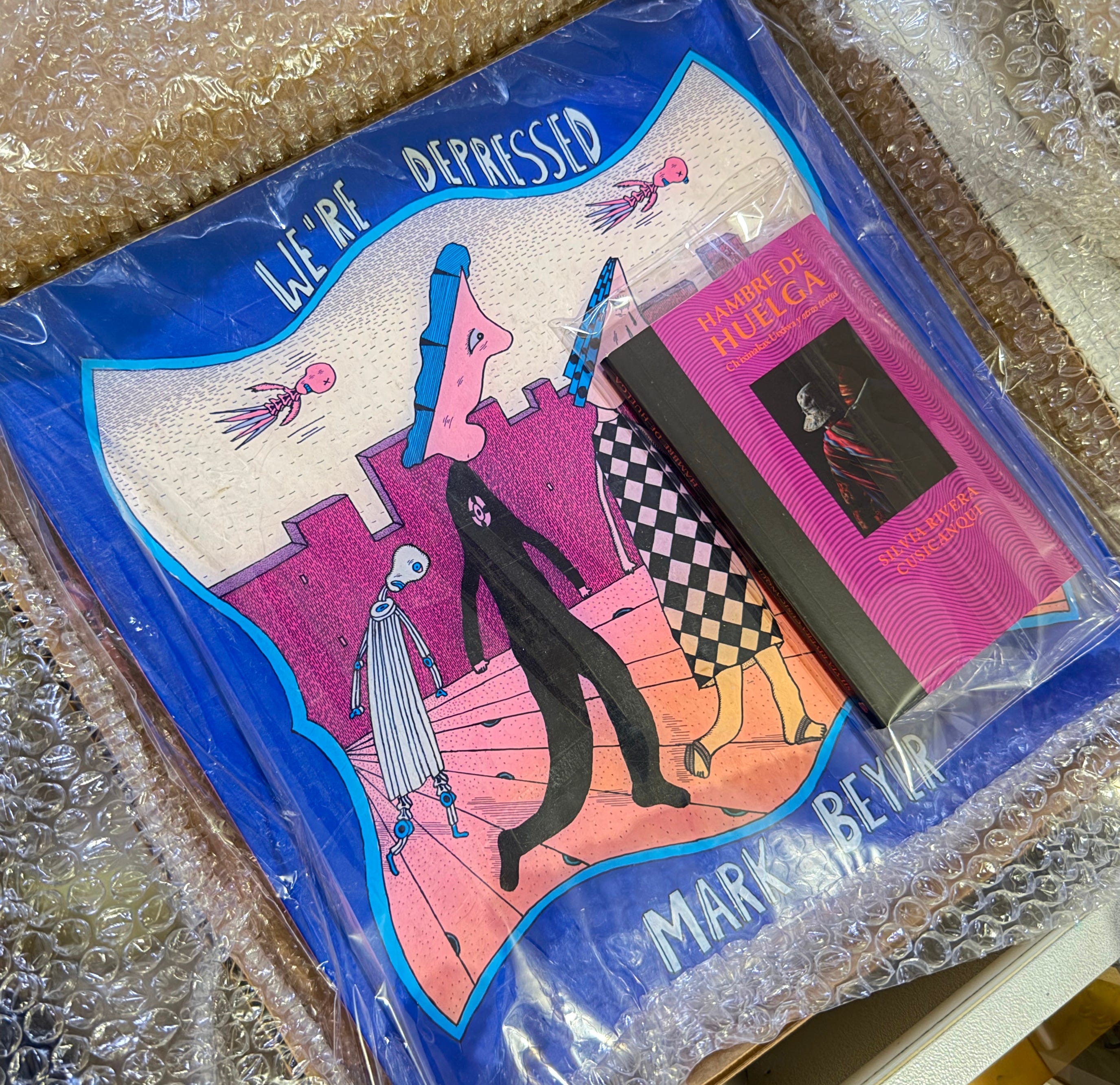
Far Corner bought Kruesel’s copy of Hambre de Huelga: Ch’ixinakax Utxiwa y otros textos by Silvia Rivera Cusicanqui, a small-press Mexican book by an indigenous Bolivian sociologist. In the same box she shipped Mark Beyer’s independently published graphic novel, We’re Depressed. The only thing these two books obviously have in common is that they have ISBNs and they’re obscure. Kruesel had the only copies available online at the time.
Last Token
Last Token is the only startup so far in the book-acquisition field. The other companies pivoted from previous book-related lines of business. Last Token is the business Kenneth Heafield founded after he left Meta. He explained Last Token’s mission on LinkedIn:
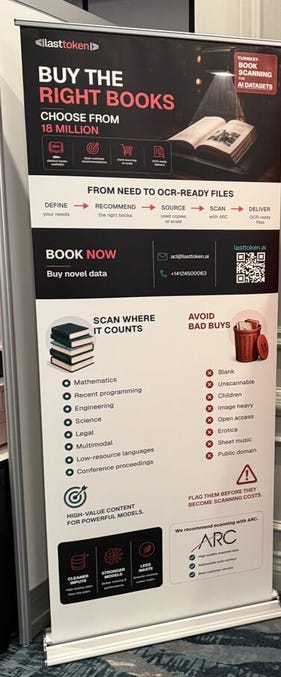
First launch product is book scanning. We integrate several metadata sources to help select books and avoid waste, buy books in our marketplace of bulk used and new sellers, ship them to scanning partners, importantly but sadly destroy the books to keep things legal per Bartz v Anthropic, and OCR.
Among the services Last Token offered on a trade show banner was filtering potential book acquisition lists for “bad buys.” Third on the list of bad buys was “children,” which is inarguable. The top item on the list was blank books, which has comic possibilities. What would an LLM make of a blank book with an ISBN that was intended as a joke, like the thirtieth anniversary edition of Dr. Alan Francis’s Everything Men Know About Women?
Last Token is one of several purchasers consolidated under Alibris’s generic “Autobuy” shipping designation, the first source of AI orders to reach used bookstores.6 Heafield’s service is already successful enough that he “paused venture capital because there is customer traction.”
Innodata
Booksellers on Amazon report that Innodata, one of the primary book scanning contractors for the Internet Archive,7 has started buying books in quantity.
Innodata just hired a senior book buyer for its new AI data program. “This is a builder role requiring entrepreneurial thinking and operational execution,” the job posting said. Among the requirements for the position was “familiarity with used-book marketplaces” including AbeBooks. Like the other AI book intermediaries, Innodata expects to buy a lot of books. The newly hired buyer will be required to “design and optimize warehousing and fulfillment operations to handle large-scale book inventory across multiple locations.”
Scanning Companies
Once an AI company acquires printed books for training purposes, they need to be scanned. At least two companies, and probably more, are providing this service.
Datamation Imaging Services
Anthropic selected Datamation Imaging Services, located in a Chicago suburb, to scan books for Project Panama. A contract released as an exhibit in the Bartz lawsuit called for Datamation to scan between 500,000 and 2 million books.
If that seems like a lot, it’s not, despite the heaps of media attention given to Anthropic’s scanning program.
ARC Document Solutions
As far as I can tell, no news outlet has reported on ARC Document Solutions, which is scanning as many books every month as Anthropic’s Project Panama envisioned scanning in its entirety.

ARC’s current rate of scanning of 2 million books per month is up from the 1.5 million books claimed on a trade show banner six weeks ago, at the beginning of July.
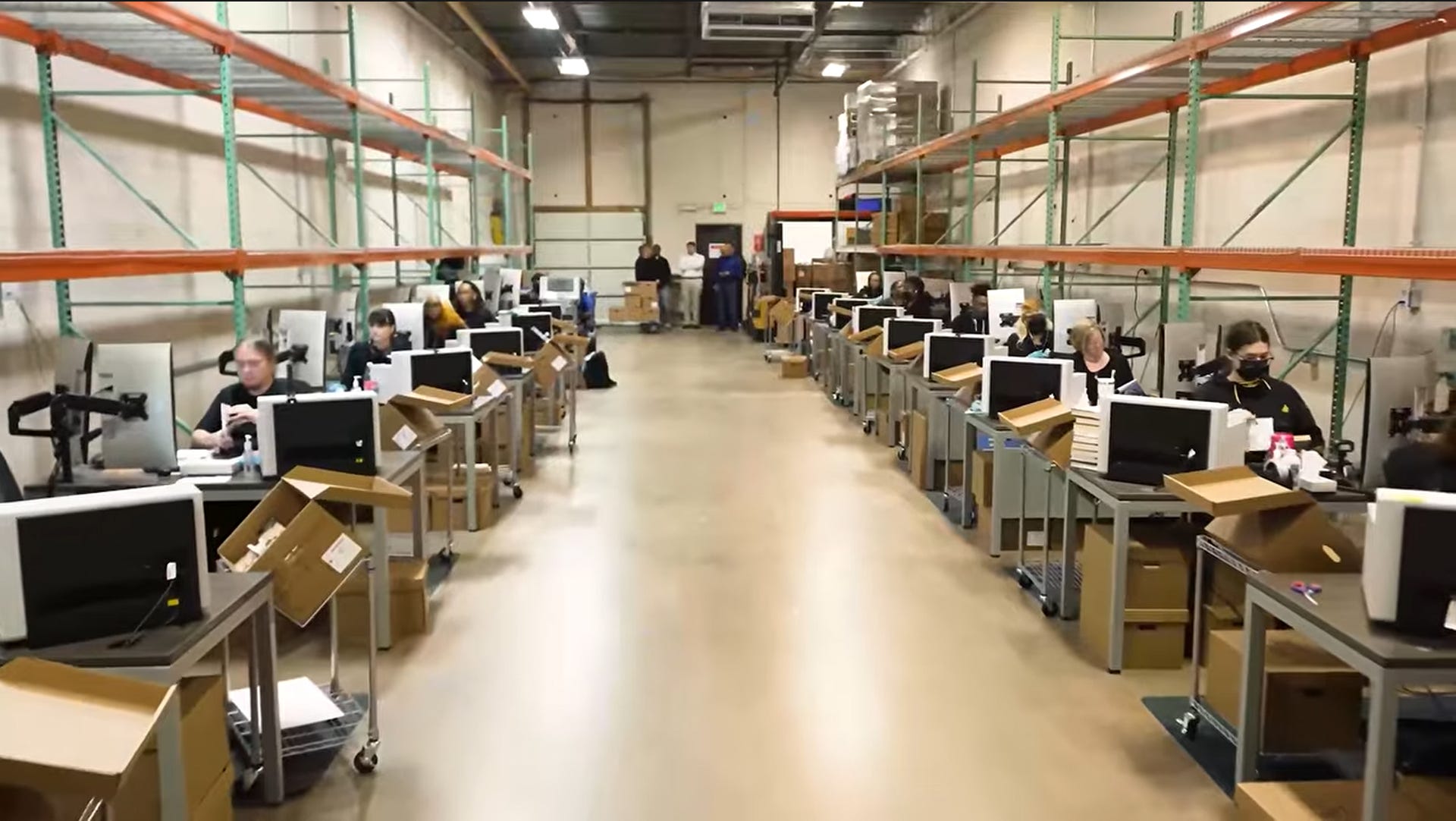
In a promotional video, an ARC executive says that many of the company’s scanning locations “run twenty-four hours a day, three shifts, including weekends,” adding, “It’s very exciting for us.”
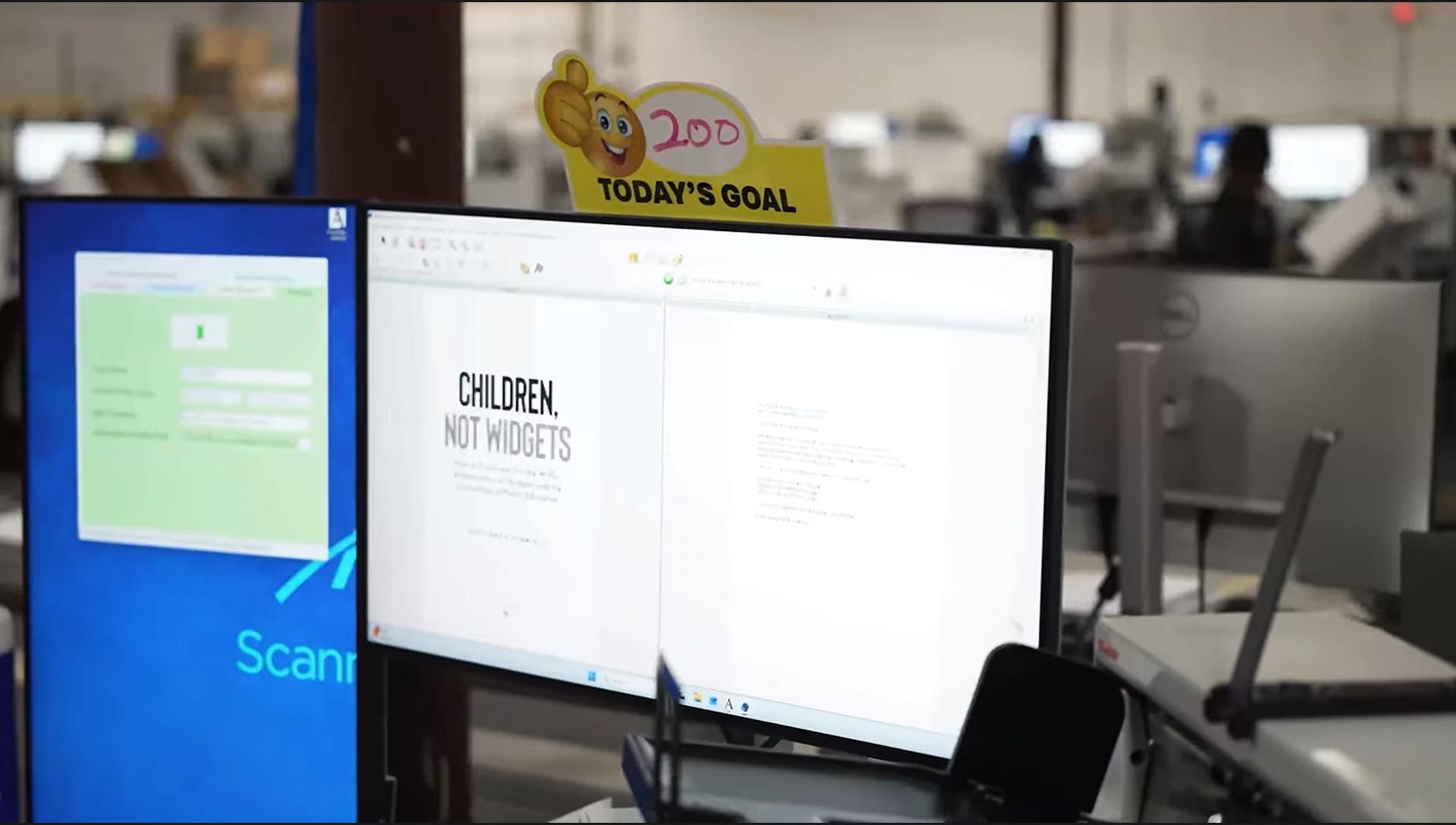
A sign above a monitor at one of their scanning facilities appears to set a production goal of 200 books per day. For a roomful of scanners, that would be about 3,000 books per shift. In a year, one group of scanners working seven days a week can process more than two million books.
Suddenly, ARC’s two-million-books-per-month claim doesn’t seem so far fetched. Do the math. That’s 20+ million books per year, and we are in the second or third year of AI book scanning. ARC is just one company. The total number of books destructively scanned to feed AI could easily be more than 50 million.
—Scott Brown, Downtown Brown Books
See footnote 4.
Calculated by comparing the World of Books Group Ltd. EBIDTA numbers for 2023 and 2025. As a British corporation, the company is required to file annual financial statements with the Companies House.
A bookseller shared a Zoom Books email with me: “I’m Manroop Gill, co-founder of Zoom Books—the largest book processor in Canada. We run two facilities and process around 200,000 books a day for institutional, academic, and library customers across North America. We’ve been buying books from [you] through online marketplaces, and I’d love to work with you directly…. We pay a 50% deposit up front, before we ever ask you to delist anything. Once your order is picked, packed, and ready to ship, we send the remaining 50%—nothing leaves your warehouse without full payment. To get started, all we need is your inventory list (ISBN, price, and stock confirmation)… We run it on our end and send you back an order.”
Zoom Books had a post on their blog about using books for AI training. The Way Back Machine captured a link to the post but not the content. The article is no longer online.
Snapshots of SuperBookDeals.com on the Way Back Machine suggest the website was working until a few weeks ago.
The source of this information is confidential, but reliable.
The Internet Archive shipped containers full of books, LPs, and other analog media to Innodata’s scanning facility in Cebu province in the Philippines. Innodata employed non-destructive methods to digitize the media, much of which was borrowed from libraries and returned. The book records on the Internet Archive website identify the location of the scanning and sometimes the person doing the work. It’s not clear if Innodata will scan for AI in the Philippines, too.
Very useful. Thanks, Scott.
Well I guess this explains why in the Star Yrek future universe most people are supposed when they encounter a physical book. However, given our real and current AI greedy companies,, I have doubts that we will achieve the ideal future envisioned by Gene Roddenberry.